Traditional POS at a Tipping Point?

A couple of studies undertaken by US publication RIS News recently got me thinking seriously about the future of retail Point of Sale systems installed at the majority of retailers today.  Is retail Point of Sale (POS) technology at a tipping point now? Could retailers potentially be facing a requirement for a major upgrade of their customer facing systems over the next 12 months?  Should they be thinking about it now?

iPad POSI feel that the answer to all of those questions is a definite “Yes”!  If so then what are these new customer facing systems going to look like?  For the answers the stats in the RIS Studies are quite illuminating.

Firstly in an RIS News study by Joe Skopura on “The Y2K Moment for POS” found here there are some great insights into the future of POS systems in the US.  No-one would argue that retailing has changed significantly and structurally over the last couple of years.  The model for physical stores is under siege “Stores are over built, downward margin pressure is a contagion, fixed costs are rising, online and mobile shopping is booming, and showrooming is catching fire”.

To be effective, POS must now be cross-channel ready and enabled where the customer wants you, when they want you, armed with the information they want – out on the shop floor with the customer.  As the hub of the customer experience the retail store can offer a powerful face to face advantage over online as long as the sales associates are empowered with the technology and information to meet the needs of the educated and now mobile equipped shoppers.

In the study 61% of retail respondents said that their POS is more that 5 years old (the number will be similar in Australia) and 48.8% noted that they would need to change in the next 12 months.  With the “Addition of Mobile POS” being the main driver to upgrade (60%) along with “Enabling Multi Channel selling in store” (60%) and “Enabling new Payment options” (52.5%).

Why POS and Why now?  Simple POS is the essential store operations platform and the pivotal enabler for additional services to improve the customer shopping experience.  To combat further erosion of market share and margins to online – retailers need to act now!  The fact that retailers are looking at mobile POS as a key driver and new (read mobile) payment options shows that retailers are looking to replace expensive fixed POS terminals and static counters with cheaper mobile devices that allow sales associates to get out from behind the counter onto the shop floor to serve the customer better at the point of decision rather than letting customers walk out the door to buy online later.

The shopper genome project

Absolutely agree. In a world where smart devices are growing like crazy and (finally!) offer the promise of the right offer to the right customer at the right time, you had better be able to follow consumers as they channel hop and to deliver permission-based, highly relevant and personalized communications.

stevenpdennis's avatarSteve Dennis

No doubt you’ve heard of The Human Genome Project–the effort to decode our species by identifying and mapping all of our genes. Ultimately it’s an effort to better understand what makes us tick, from both a functional and physical standpoint.

As a business or brand leader you have a similar challenge when it comes to decoding your current and potential consumers’ attitudes, needs and behaviors.

In a world of vast and growing choices, the pressure is only increasing to develop deep, actionable insight into your customer base.

In a world where most segments are growing slowly, your only chance for out-sized growth is to gain market share. And that requires understanding which levers to pull that are compelling enough to win new clients or grow share of wallet with existing ones.

In a world where most competitors are either engaged in a race to the bottom or stuck in tired…

View original post 141 more words

Future of mobile: 5 takeaways from Mobilize 2012

The “point of sale” is now everywhere.

Kevin C. Tofel's avatarGigaom

A long, early Saturday flight home highlighted the end of our Mobilize 2012 event, giving me plenty of time to digest all of the salient points made by our speakers and panelists. Many of these spoke to not only the current state of mobile, but the future too. And that future is fast approaching as we’re watching improvements in mobile broadband networks, better software tools, smarter app discovery engines, and hardware cycles that are revving faster than ever.

Some of the more poignant thoughts from our Mobilize speakers exemplify this theme, so here are a few I thought worth sharing:

View original post 368 more words

The Battle For Smartphone Supremacy – Infographic

V.'s avatarThe Main Street Analyst

How often do you use your smartphone to peruse a website? According to a recent survey, over the course of the past year visits to leading ecommerce websites from consumers’ mobile devices have skyrocketed. And the battle for smartphone supremacy is intensifying.

The infographic below illustrates the direction in which the mobile commerce is headed, and shows the race between iPhone and Android.

Digital marketing technology company Monetate issued the report from which this information is extracted. The report analyzed more than 100 million online shopping experiences to come up with the data below.

Have you shopped more frequently from your mobile device in the past year?

Source: Mashable.com, Monetate

View original post

Retailers need to get an App, online isn’t enough

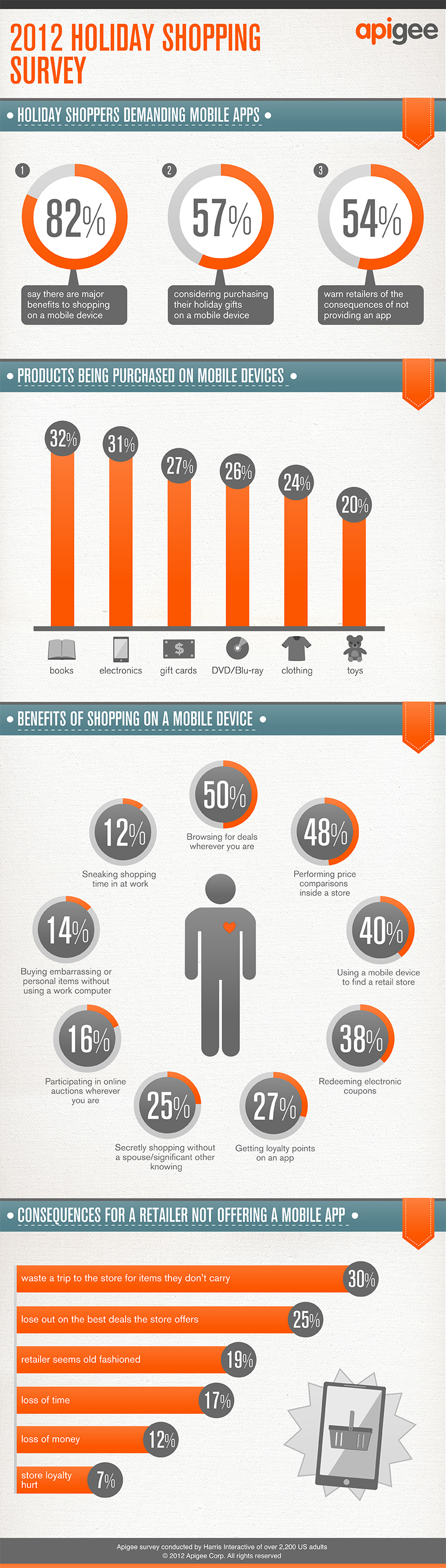
A recent survey conducted in the USA by Harris Interactive for Apigee, an online API management platform, has indicated that shoppers will be using their mobile phones more than ever.  Many smartphone users have come to expect more than just an online presence from retailers, especially the younger demographic – where a smartphone app is becoming more important, as it allows them to do more when they are out shopping.  Venture Beat Article is here.

Mobile App Survey results

Mobile app usage in retail

Apple’s expanding retail store staffing levels

On the 26th June, an interesting article appeared in the online publication Technology Spectator by Horace Dediu from the Helsinki based company Asymco.  It was about “Expanding Apple’s Retail Army“, specifically about Apple’s retail store staffing practices.  The full article is available by clicking here

The basic premise from the article is that Apple has in the last 5 years tripled the number of employees per retail store from 37 in Q1 2007 to 117 in Q1 2012 and yet still retains extremely high per employee profitability and sales.  See the graph below:

Apple has also set the benchmark for retail in terms of sales and profit per square foot (more than double 2nd placed Tiffany’s) as well as sales and profit per employee.  Last year in Apple’s 327 stores globally each Apple retail store employee brought in $473,000.

The products are desirable and the staff are astonishingly good at selling them (even though they are not on commission).  There have been some rumblings about staff wage levels and staff retention in the US, however there is always a plentiful supply of bright young people lining up to apply for jobs at Apple stores – they can still take their pick of the best.  Why is this?

I think it has a lot to do with the strong Apple brand and the consistency of the customer experience with Apple products;  whether that is online, in store or when they get home an unbox the latest iPhone or iPad.  A consistently great experiences.

Store staff are well trained and empowered to solve customer problems straight away, they have access to all the information they need on their iPod Touch or iPad and their store retail application is well integrated with their website including their Genius Bar booking system.  Apple are even taking this a step further with their Apple Store iPhone app where customers can go into a store and buy a (admittedly a lower price point) product and pay for it with their iTunes account using their iPhone and walk out – without the need to even interact with any Apple Store staff.

Recently Apple’s new head of Retail John Browett, who took the reins in April, was looking at tinkering (read reducing) with Apple’s store staffing levels, using new schedules and staffing formulas.  However this was quickly hit on the head (most likely by CEO Tim Cook), with Browett coming out and saying that “We messed up”.

With all the doom and gloom about retail and retail store staff employment prospects – Apple is showing the way by increasing store staffing levels.  In difficult retail conditions Apple is still setting a stellar example for retailers to follow:

  • It’s all about the brand and a consistently good customer experience
  • Stores are well staffed by well trained, engaged and motivated employees
  • Store staff are empowered to solve the customers problem there and then
  • Store staff have the mobile tools and information they need  on the floor
  • Online and in-store systems are consistent and well integrated
  • Customers are given all the information they need in store on their iPhone or iPad