Well, September has been another big month for mobile technology with the big release of the new Apple iPhone 5. After months of rumours about what it would and wouldn’t contain, it all became clear on the 12th with the Big Launch event and more so on the 21st when the iPhone 5 actually went on sale and people could wait in line again to try it out for themselves. Except for the new iOS 6 Apple Maps application replacing Google Maps, the feedback on the phone and iOS 6 has largely been very positive (and maps will definitely get better, Google has had a 7 year head start in mapping).
It was very interesting that Apple chose not to release NFC (Near Field Communication for mobile payments) with this version of the iPhone (see this post for more on this). With the sheer number of patents Apple has that rely on NFC for payments, for shopping applications and for data transfer, you would have to believe that Apple have chosen to wait and see rather than completely abandon the technology. It will also have something to do with the fact that in the USA, up until now, there hasn’t been much of a mandated push to replace the existing mag stripe payment terminals in millions of retail outlets, so there just wasn’t the critical mass of terminals capable of reading the NFC chip out in the stores. However faced with increased fraud risks, the Credit Card companies have now started the push for EMV (Chip & Pin) in the US as well – a little later than the rest of the world, but still, it’s the US – the biggest market. Most of these new EMV payment terminals will also come with Contactless readers as well which are capable of reading the NFC chip.
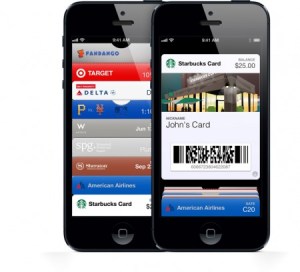 Apple has also just released their Passbook app in iOS 6 which creates a wallet on the phone to store Discount Coupons, Loyalty Cards, Gift Cards, Airline boarding passes and Concert Tickets – anything that has a barcode or 2D QR Code that can be scanned at Point of Sale. Apple would also be adopting the wait and see attitude to Passbook, given that app developers now have to update their apps to support the new features and capabilities of Passbook. However early adopters in retail in the USA include Sephora with more than 20,000 downloads of their “Beauty Insider” card only 2 days after iOS 6 was launched (see here for the Sephora link), and Starbucks, who will add support for their Starbucks Card by the end of this month. Apple will be waiting to see how various retailers choose to support Passbook before inevitably adding mobile payment support to Passbook.
This will give others the opportunity to get a bit of a head start in mobile payments and test the US waters. Google has already made good progress with Version 2 of the Google Wallet, now with multiple Credit Card support and a number of iOS Passbook-like features supporting Coupons and Loyalty Cards but still relying on the phones NFC capability for payment. PayPal Here for payments at Point of Sale is starting to gain traction with major retailers after Home Depot, Abercrombie & Fitch, JC Penney, Foot Locker, Office Depot, Toys R Us and others joined up, not requiring NFC for payment. Square’s “Pay with Square” app allows for payment at selected retailers with the Square POS app to pay by just saying their name (or in Starbucks by scanning a barcode) and earning rewards.
On the merchant side, PayPal, Square, iZettle and now Groupon have all come out with dongles that plug into the phones audio socket and accept card swipes for payment – with new entrants appearing in this space every second week. What is really required however, is the security offered by EMV and Contactless payments. That is where the traditional payment terminal manufacturers like Ingenico and Verifone have come out with secure payment add-on devices supporting EMV that work with the iPhone and iPad for a true pay anywhere capability.
Finally, the key benefit of NFC that seems to have been overlooked by the people who have prematurely announced that it is dead, is that it will still ride on the back of the existing payments infrastructure (networks, terminals, systems) that have been put in place over the last 30 years by the banks, credit card companies and payment networks.
However, with over 435 Million (that’s right 435 Million) iTunes user accounts globally all with payment card details, Apple still holds a huge trump card in one click mobile payments. Still betting it will be with NFC and it will make use of Passbook. It is now all about the timing.



 MyRetailCloud Blog